Welcome to our community

Be apart of something great, join today!

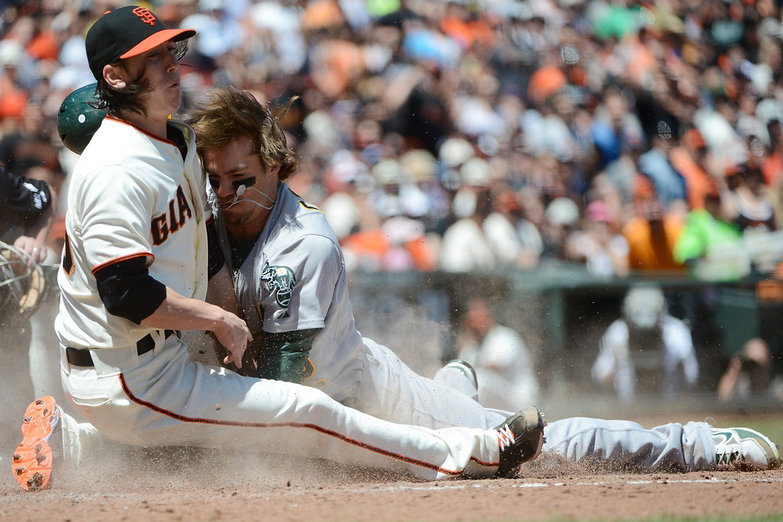
I guess this is one way to stop a runner from scoring...

Disclaimer: Links on this page pointing to Amazon, eBay and other sites may include affiliate code. If you click them and make a purchase, we may earn a small commission.

hive17

Active member
Joined
Aug 7, 2008
Messages
21,426
Reaction score
24
Why are the rules so loose about the catcher blocking the plate and/or the runner colliding with the catcher; yet when a situation like this arises (a fielder or pitcher fielding covering home), it's clearly a violation?

It's illegal for anyone to block the baseline without the ball, but catchers get a ton of leway all the time. If this pitcher had been fielding the ball, does he have the right to block the plate? If not, why not? If so, then why does the runner have the right to make violent contact with the fielder, but the reverse is not allowed?

Like I said, we can all agree that the pitcher was probably wrong here, but there are som hypocracies when it comes to multiple people colliding at home.

 

fordman

Well-known member
Joined
Feb 22, 2013
Messages
3,191
Reaction score
37
Location
Ohio
Why are the rules so loose about the catcher blocking the plate and/or the runner colliding with the catcher; yet when a situation like this arises (a fielder or pitcher fielding covering home), it's clearly a violation?

It's illegal for anyone to block the baseline without the ball, but catchers get a ton of leway all the time. If this pitcher had been fielding the ball, does he have the right to block the plate? If not, why not? If so, then why does the runner have the right to make violent contact with the fielder, but the reverse is not allowed?

Like I said, we can all agree that the pitcher was probably wrong here, but there are som hypocracies when it comes to multiple people colliding at home.


The Catcher has the right to protect the plate if a play is being made. The pitcher in this instance didnt protect the plate, he intentionally collided with the runner 6 feet from the plate. The pitcher had malicious intent to keep the runner from scoring and the pitcher wasnt part of making the play as he didnt look to the catcher or open his glove to catch the ball to make a tag.

Without the interference from the pitcher, it obvious the runner would have scored. The second runner that touched the plate probably would have made an attempt at the plate if the collision wouldnt have happened, so he may have been awarded homeplate as well. We dont see the outcome in the video clip.

Fordman
 
Last edited:

hive17

Active member
Joined
Aug 7, 2008
Messages
21,426
Reaction score
24
The Catcher has the right to protect the plate if a play is being made. The pitcher in this instance didnt protect the plate, he intentionally collided with the runner 6 feet from the plate. The pitcher had malicious intent to keep the runner from scoring and the pitcher wasnt part of making the play as he didnt look to the catcher or open his glove to catch the ball to make a tag.

Without the interference from the pitcher, it obvious the runner would have scored. The second runner that touched the plate probably would have made an attempt at the plate if the collision wouldnt have happened, so he may have been awarded homeplate as well. We dont see the outcome in the video clip.

Fordman

Thanks.

But I'm kind of setting aside this instance, and asking about the over-all situation. Does the pitcher have a right to block the plate like a catcher does (at some serious risk to the pitcher, no doubt)?

In the MLB, the note on rule 7.06 says that the catcher has to be fielding the ball or be in possesion, otherwise he's obstructing. I'm assuming that "fielding" means that the ball is moving towards the fielder. But we see catchers get a lot of leeway when it comes to setting up for the block. I don't know of an instance where a catcher has ever been called for obstruction at home plate. That means that every catcher is always perfectly acting inside the rules, or that the umps just don't care (I assumed it's the latter).

So, can a pitcher block the plate?
 

MrMet

Well-known member
Joined
Apr 6, 2010
Messages
13,556
Reaction score
612
Location
The Poconos
I would assume, say in a passed ball situation where the catcher goes to get the ball and the pitcher covers home, he could block the plate, but without all the protective padding the catcher wears, taking a collision would be very ill advised from the pitchers standpoint, and is probably why we don't see it
 

Hallsgator

New member
Joined
Aug 7, 2008
Messages
4,354
Reaction score
0
Location
Charleston, SC
sure pitchers can block the plate. but they will probably end up like timmy here


144909057.0_standard_783.0.jpg
 

bongo870

Well-known member
Joined
Sep 30, 2009
Messages
3,606
Reaction score
548
Location
Marlton NJ
Thanks.

But I'm kind of setting aside this instance, and asking about the over-all situation. Does the pitcher have a right to block the plate like a catcher does (at some serious risk to the pitcher, no doubt)?

In the MLB, the note on rule 7.06 says that the catcher has to be fielding the ball or be in possesion, otherwise he's obstructing. I'm assuming that "fielding" means that the ball is moving towards the fielder. But we see catchers get a lot of leeway when it comes to setting up for the block. I don't know of an instance where a catcher has ever been called for obstruction at home plate. That means that every catcher is always perfectly acting inside the rules, or that the umps just don't care (I assumed it's the latter).

So, can a pitcher block the plate?

There is a difference between running into the runner and blocking the plate. A catcher can block the plate if a play is in progress. But noone can just run down a runner. And I believe anyone can block the plate when a play is in prosses but like others say without gear it will not be a good.
As far as this play goes here is what I seen:
"As the video shows, the incident started when Hendrix batter Matt Simmons called timeout just as Austin was about to deliver to the plate.Incensed over the timeout, Austin appeared to throw at Simmons, which apparently drew a response from Radack. On the next pitch, the 6-4, 205-pound Austin threw a wild pitch, then took down the 6-3, 200-pound Radack. Austin, naturally, was ejected, and Radack was awarded home plate. The run gave Hendrix (5-8) a 7-2 lead.
Maybe the dust-up was the spark Berry needed. The Vikings (5-6) scored three runs in the sixth, two in the seventh and two in the eighth to rally for a 9-7 win."
 

Members online

Latest posts

Top